Showing posts with label Facts. Show all posts

Friday, April 1, 2011

The History of Science Fiction [Unfreakingbelieveable Infographic]

The History of Science Fiction [Unfreakingbelieveable Infographic]: "
I know, I know… unfreakingbelievable isn’t a word, is it? It doesn’t even matter because you’ll forget all about that when you see this mind-blowing insanely well put together infographic on the history of science fiction. You could literally spend 30 minutes staring at this thing and still not capture all the information. You could probably learn more from this infographic than from twenty years of watching science fiction movies.

I still can’t decide what I’m more impressed with, the way this information is illustrated or the facts themselves. The extra crazy part is, I don’t know who made this so I can’t give credit to any one specific person. I know it is on Scimaps, but that’s all I’ve got. It looks like it was created in 2009 by someone with the word “Shelly” in the name, but there simply isn’t enough to go on.

Whether you are into Lord of the Rings, Aliens, Star Trek, or any of those obscure movies you thought you were the only one that liked, you will enjoy this. Sit back, relax, and get ready to be schooooooled! “Science fiction deal with improbable possibilities, fantasy with plausible impossibilities.” ~Miriam Allen de Ford


Click Here For The Full Image
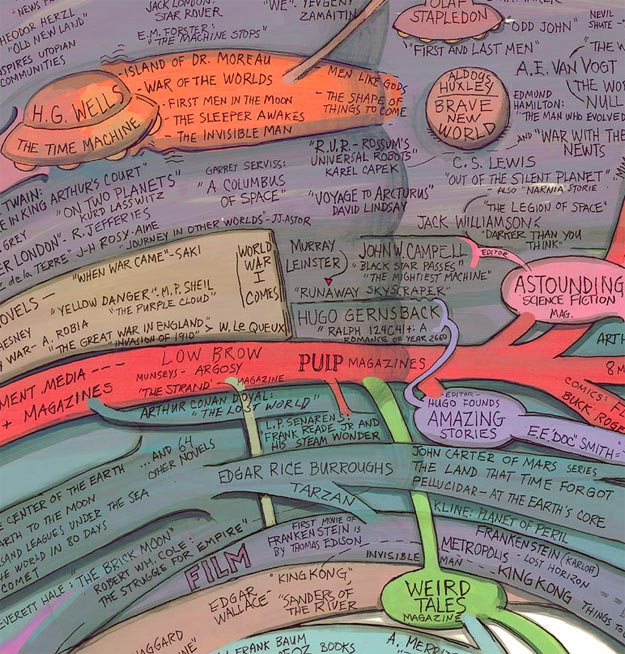


Detailed Science Fiction Infographic

Via: [Nuclear Toast]
"

Saturday, June 5, 2010

Creative people are just high functioning schizophrenics

Creative people are just high functioning schizophrenics: "
New research shows a possible explanation for the link between mental health and creativity. By studying receptors in the brain, researchers at Karolinska Institute have managed to show that the dopamine system in healthy, highly creative people is similar in some respects to that seen in people with schizophrenia.


High creative skills have been shown to be somewhat more common in people who have mental illness in the family. Creativity is also linked to a slightly higher risk of schizophrenia and bipolar disorder. Certain psychological traits, such as the ability to make unusual or bizarre associations are also shared by schizophrenics and healthy, highly creative people. And now the correlation between creativity and mental health has scientific backing.


'We have studied the brain and the dopamine D2 receptors, and have shown that the dopamine system of healthy, highly creative people is similar to that found in people with schizophrenia,' says associate professor Fredrik Ullen from Karolinska Institutet's Department of Women's and Children's Health, co-author of the study that appears in the journal PLoS ONE.


Just which brain mechanisms are responsible for this correlation is still something of a mystery, but Dr Ullen conjectures that the function of systems in the brain that use dopamine is significant; for example, studies have shown that dopamine receptor genes are linked to ability for divergent thought. Dr Ullen's study measured the creativity of healthy individuals using divergent psychological tests, in which the task was to find many different solutions to a problem.


'The study shows that highly creative people who did well on the divergent tests had a lower density of D2 receptors in the thalamus than less creative people,' says Dr Ullen. 'Schizophrenics are also known to have low D2 density in this part of the brain, suggesting a cause of the link between mental illness and creativity.'

The thalamus serves as a kind of relay centre, filtering information before it reaches areas of the cortex, which is responsible, amongst other things, for cognition and reasoning.


'Fewer D2 receptors in the thalamus probably means a lower degree of signal filtering, and thus a higher flow of information from the thalamus,' says Dr Ullen, and explains that this could a possible mechanism behind the ability of healthy highly creative people to see numerous uncommon connections in a problem-solving situation and the bizarre associations found in the mentally ill.


'Thinking outside the box might be facilitated by having a somewhat less intact box,' says Dr Ullen about his new findings.


From www.sciencedaily.com. Posted by Jedi Mind Traveler."